

A leading researcher has called for Papua New Guinea to unlock new income streams for its coffee industry through carbon trading, as part of efforts to revive declining production and support rural livelihoods.
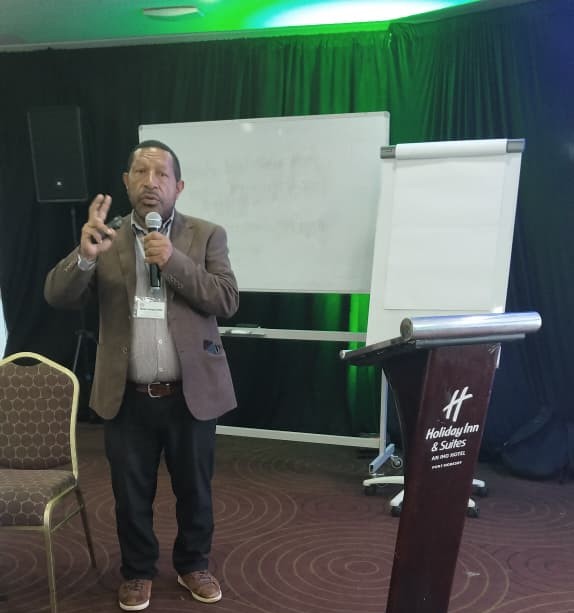
Speaking at the Climate Smart Coffee Policy Validation Workshop in Port Moresby, Dr. Mawe B. Gonapa, stressed that stakeholders must first understand the science and systems behind coffee production before advancing policy discussions.
Dr. Gonapa said coffee, traditionally valued for products such as cherry, parchment, green beans and roasted coffee, also holds untapped potential through its ability to store carbon.
He explained that coffee is a tree crop that qualifies for carbon trading under international frameworks, as it absorbs carbon dioxide and stores it as biomass both above and below ground.
“Coffee sequesters carbon. That carbon can be measured, valued and traded, creating an additional income stream for farmers,” he said.
According to Dr. Gonapa, the global demand for carbon-neutral coffee is growing, with major buyers such as Starbucks seeking millions of tonnes of certified supply.
He noted that Papua New Guinea’s coffee industry currently generates approximately K1 billion annually and supports close to three million people with about 400, 000 farming households actively involved in production.
Despite its importance, he said production has been declining since the 1980s due to factors such as poor infrastructure, limited extension services and price volatility.
Dr. Gonapa compared PNG’s performance with countries like Vietnam, which has grown into one of the world’s top coffee producers over the same period.
He said carbon trading could act as a catalyst to reverse this trend by incentivising farmers to plant more trees and rehabilitate aging coffee blocks.
“Off-season, farmers can rely on carbon credits as an additional source of income, with trading periods lasting between 25 to 30 years.”
The proposed policy focuses on three key areas: carbon measurement, policy alignment and capacity building for farmers.
Dr. Gonapa highlighted that accurate measurement is critical, with methods such as allometric equations and chemical analysis being identified as feasible approaches for PNG.
He added that aligning with international and national frameworks including mechanisms under the Intergovernmental Panel on Climate Change and REDD+ is essential to ensure credibility and compliance.
The policy also places strong emphasis on smallholder farmers, who contribute up to 85 percent of PNG’s coffee output.
Dr. Gonapa said improving shade-grown coffee systems would not only enhance quality but also increase carbon storage potential making the crop more valuable in both traditional and carbon markets.
He pointed out that other coffee-producing countries, including Colombia, Kenya and India, have already been participating in carbon trading for years.
“Why not PNG take up the challenge?” he asked.
Dr. Gonapa further stressed the need to bridge the gap between science and policymaking in the country, noting that research findings are often not effectively integrated into policy development.
“We have a lot of policies in PNG, but the interface with science is lacking.”
Moreover, he proposed a cooperative-based model to help farmers participate in carbon markets, supported by government agencies, provincial administrations and international certification bodies.
The workshop brought together stakeholders from government, industry and development partners to validate the proposed Climate Smart Coffee Policy, which aims to position PNG’s coffee sector as both economically resilient and environmentally sustainable.