
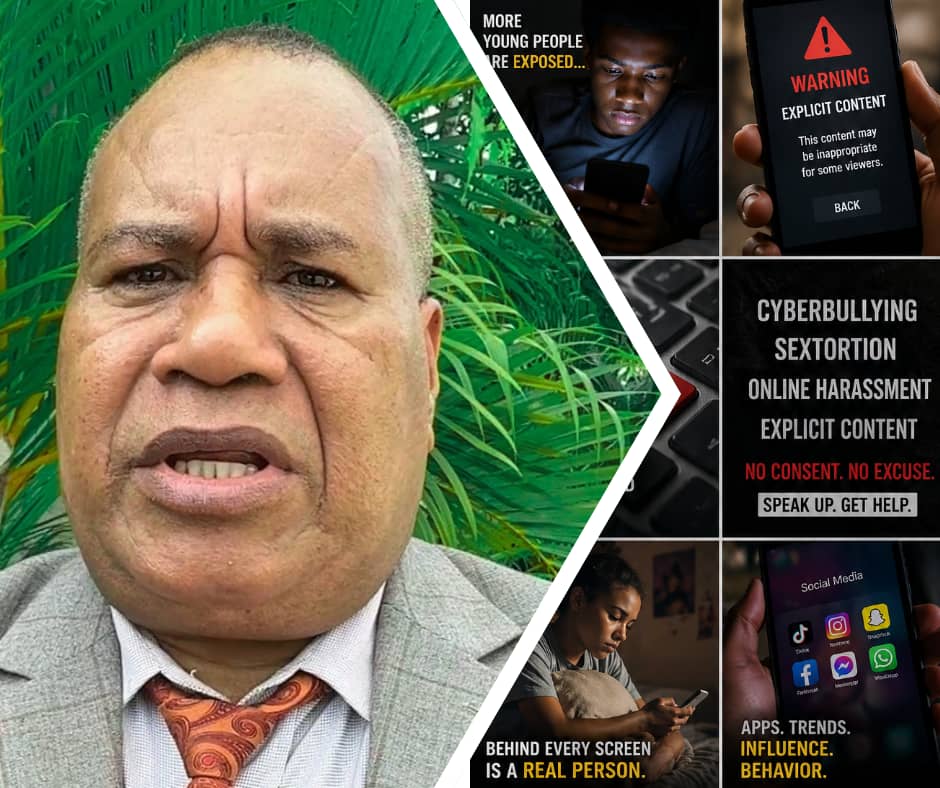
The conversation around explicit content in Papua New Guinea is no longer just about what comes from outside. It is changing shape, and quietly, it is moving closer to home.
With growing concern over how digital platforms are influencing young people, Chief Censor of the Office of Censorship Jim Abani, spoke to PNG HAUSBUNG to clarify what is really happening behind the scenes.
For years, the country’s focus remained on blocking foreign content. While that was once the primary frontline, that line is now starting to blur.
“Actually, our focus was on what was coming in from outside,” Mr Abani said, explaining how censorship efforts were initially designed to filter imported material.
Now, technology has shifted the game. He acknowledged that while there has been limited reporting of locally produced explicit content, the rise of mobile access and digital tools is opening that possibility.
“I believe with the infrastructure that we built and now going online, we will come across this in the coming years.”
That shift matters because once production becomes local, control becomes harder, distribution becomes faster, and the impact becomes more personal.
Behind the scenes, efforts are already underway to respond. The Office of Censorship is working alongside the National Information and Communications Technology Authority (NICTA) to identify and block harmful content.
“We identify prohibited content and provide that to NICTA to work with service providers to block it,” Mr Abani explained.
But even that system has limits; the internet does not sit still, and neither do the people using it. The fight is not just technical; it is human.
Through the Censorship Ambassador School Program run in partnership with the National Department of Education, the focus is shifting toward awareness to the young minds, because the real issue is not just access, but behaviour.
Cyberbullying, online harassment, and more serious forms of exploitation are rising alongside content exposure.
“These issues are now emerging in Papua New Guinea,” Mr Abani said, pointing to a growing pattern that cannot be ignored.
When it comes to those affected, especially young girls, the response is limited but critical.
“The only support we can give is counselling as we refer them to relevant agencies.”
“It is not a perfect system, but it is one of the few lifelines currently in place.”
In addition, there is also a legal side building in the background. Authorities are pushing for stronger collaboration across agencies, using existing laws to identify offenders and bring them into the justice system.
Yet, beyond law and enforcement, the message becomes more personal- less about control but more about responsibility.
“Censorship starts at home,” Mr Abani said, offering the statement not as a slogan, but as a reality check.
In a country where technology is moving faster than guidance, the first line of control is no longer the system, it is the individual.
What this conversation reveals is simple, but unsettling as Papua New Guinea is no longer just consuming digital influence but it is beginning to create it and that changes everything.
Once the problem becomes local, it stops being distant. It becomes cultural, it becomes social, it becomes real.
Therefore, the question is no longer whether the system can keep up, but whether the people will.