

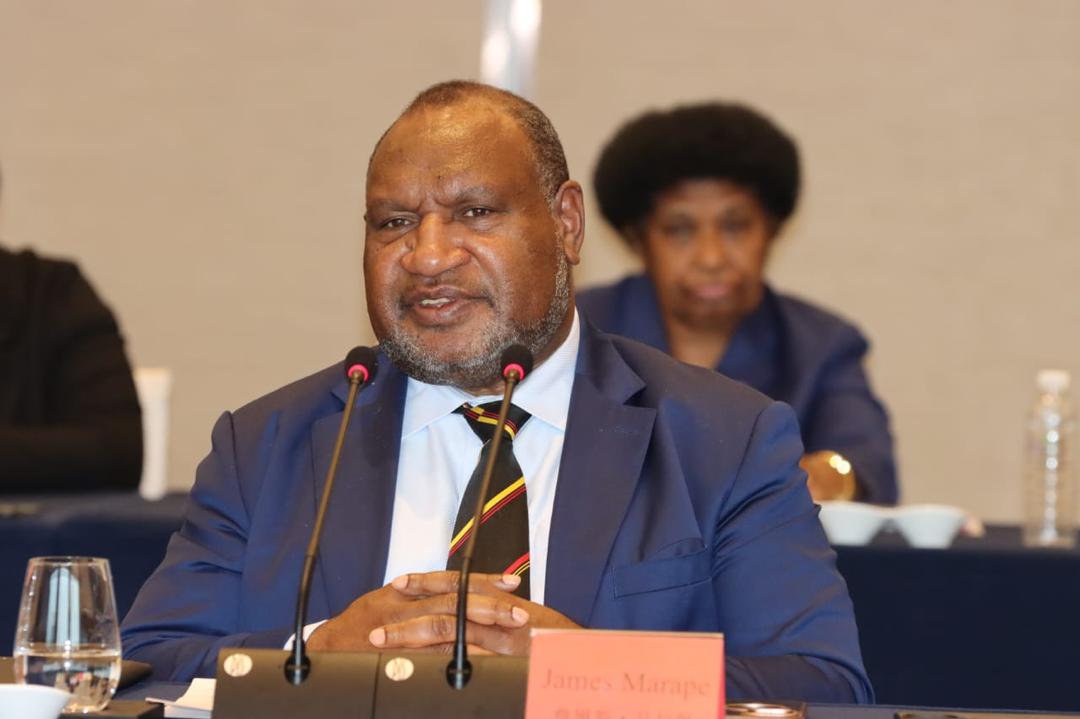
Prime Minister James Marape has reaffirmed Papua New Guinea’s commitment to strengthening economic ties with China, telling top investors the country is ready to expand trade, investment and long-term partnerships.
Speaking at the PNG–China Roundtable in Guangdong Province, Marape highlighted the strong and enduring relationship between the two nations and encouraged Chinese businesses to explore opportunities across key sectors of PNG’s economy.
Addressing government officials and business leaders, he described Guangdong as a model of economic success, representing the strength of China’s commercial and industrial development.
Reflecting on a past meeting with Chinese President Xi Jinping, Marape said he was once told China would “give Papua New Guinea Guangdong” a statement he now interprets as a symbolic gesture of offering the very best of China’s economic expertise and innovation.
He acknowledged the longstanding contribution of Chinese communities to Papua New Guinea’s development since independence in 1975, paying tribute to leaders of Chinese heritage, including former Prime Minister Julius Chan.
“As we mark 50 years of independence, we recognize and thank our Chinese partners and investors who have helped shape modern Papua New Guinea,” Marape said.
Marape stressed that PNG remains open to investment across a wide range of sectors, including resources, agriculture, fisheries, forestry, tourism, manufacturing and retail.
He said the government is rolling out reforms to improve the business environment, particularly through the Investment Promotion Authority. These include streamlined processes such as one-stop investor services, faster registrations, 24/7 online systems, and improved regulatory transparency.
“We want investors to have confidence and certainty when choosing Papua New Guinea,” he said.
The Prime Minister noted that PNG’s economy is stabilizing following the global impacts of the COVID-19 pandemic, with the budget deficit significantly reduced and a balanced budget in sight.
“We are managing the economy responsibly to ensure a stable environment for investors,” he said, adding that PNG continues to offer competitive returns compared to other emerging markets.
Marape assured investors that PNG’s democratic system and independent judiciary provide strong protection for lawful investments.
“We are governed by the rule of law and all legitimate contracts will be upheld,” he said, citing long-term projects like the Ramu Nickel Mine as examples of investment continuity.
The Prime Minister reaffirmed PNG’s support for the One China Policy, first adopted under founding Prime Minister Michael Somare.
“Our position remains unchanged, we respect China’s sovereignty just as China respects ours,” he said, thanking Beijing for its continued support, including land allocated for PNG’s embassy.
Marape described Guangdong as a vital link for PNG’s engagement with China, while positioning Papua New Guinea as a gateway for Chinese access to Pacific markets.
“Guangdong is our bridge into China, and PNG will be China’s bridge into the Pacific,” he said.
He encouraged investors to work through PNG’s diplomatic and trade offices to accelerate genuine investment opportunities.
The Prime Minister also announced incentives for investors willing to establish value-adding industries in PNG, including tax holidays of up to 10 to 15 years for sectors such as timber, fisheries, mineral processing and petroleum-based manufacturing.
“We want to move beyond exporting raw materials and instead build industries that create jobs and add value locally,” he said.
He added that PNG’s access to major markets including APEC, ASEAN-linked economies, Pacific nations and the European Union provide a strong platform for export growth.
Closing his address, Marape called for stronger global cooperation and partnership.
“In a divided world, we need more collaboration, understanding, and leadership to achieve shared prosperity,” he said.
“Let Guangdong remain a bridge into Papua New Guinea, and Papua New Guinea a bridge into China and the Pacific.”