

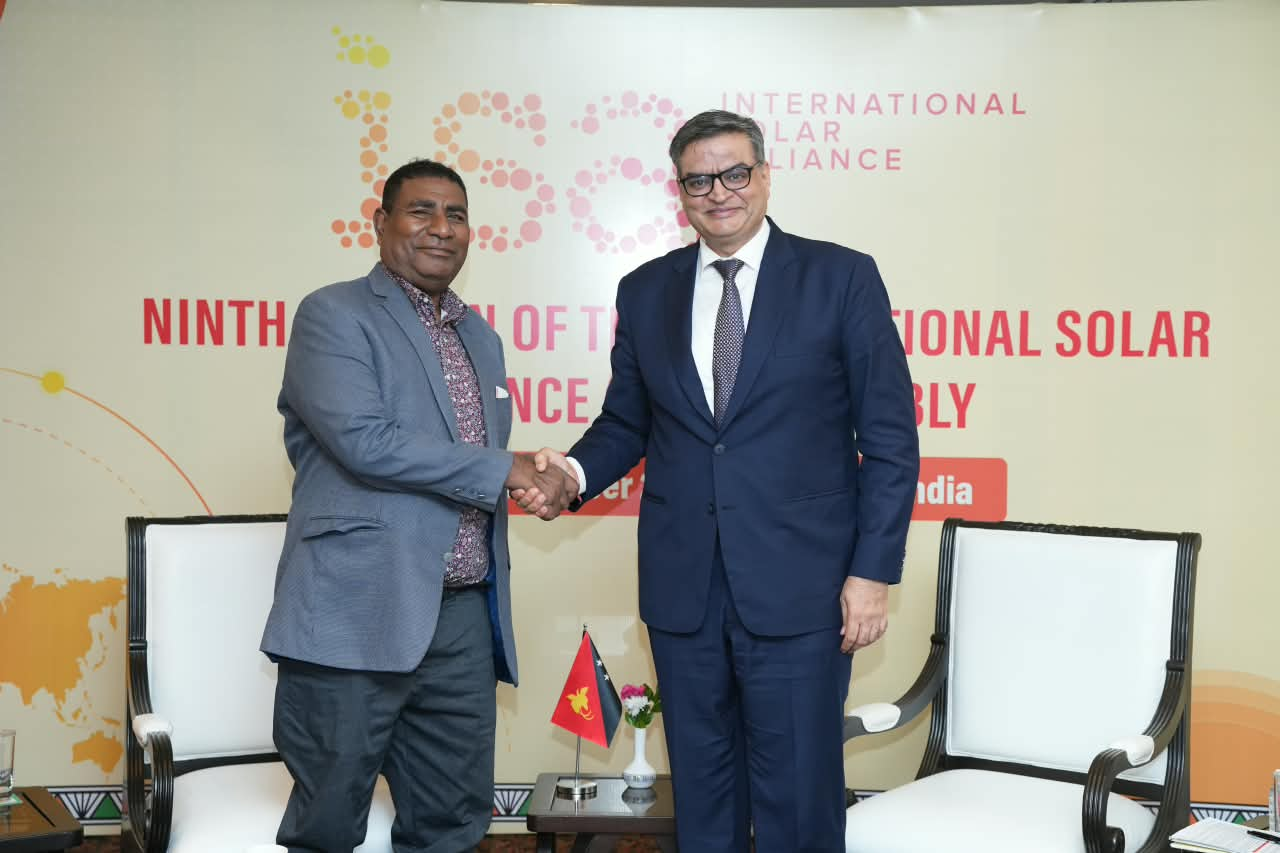
Papua New Guinea is officially ready to transition from drafting renewable energy policies and regulations to implementing practical, on-the-ground projects, with solar power identified as the primary vehicle to expand electricity access across rural, remote, and island communities.
The declaration was delivered by Minister for Energy, Hon. Peter N. Isoaimo, MP, during his country statement at the Ninth Session of the International Solar Alliance (ISA) Assembly in India on Monday. Minister Isoaimo led the high-level Papua New Guinea delegation, which included senior representatives from the National Energy Authority (NEA).
Papua New Guinea continues to face severe challenges in electricity penetration. The country’s exceptionally rugged terrain, highly dispersed populations, and prohibitive infrastructure costs mean a significant majority of rural settlements and outer islands remain completely isolated from conventional power grids.
Minister Isoaimo stated that decentralized renewable energy—specifically solar power—offers the most practical, resilient, and cost-effective solution to bridge this energy gap. He reaffirmed the National Government's commitment to renewable energy as a core catalyst for inclusive economic growth under PNG Vision 2050.
Through the NEA, Papua New Guinea has already established robust policy frameworks and regulatory foundations, including a comprehensive National Solar Roadmap. The immediate priority, according to the Minister, is translating these frameworks into bankable programs, investment opportunities, and scalable projects.
“Our message is clear. Papua New Guinea is ready to advance from policy and regulatory development to practical implementation,” Minister Isoaimo told the Assembly.

To fast-track this transition, Papua New Guinea formally called for a structured, delivery-focused partnership with the International Solar Alliance to convert its renewable energy ambitions into viable physical assets.
Minister Isoaimo welcomed the ISA’s global mandate for project preparation, capacity-building, and strategic resource mobilization. He explicitly invited the Alliance to collaborate with the NEA to map out priority projects, target technical assistance needs, identify international financing partners, and establish rigid implementation timelines.
Crucially, the Minister highlighted the necessity of bridging Papua New Guinea with development finance institutions (DFIs), private sector capital, and international technical partners to mobilize the substantial funding and expertise required for long-term sustainability. He urged the ISA to move beyond general policy advisory roles and actively assist the country in assembling bankable, investment-ready rural solar mini-grids.
For Papua New Guinea, expanding renewable energy infrastructure extends far beyond environmental targets. Providing isolated communities with reliable electricity is expected to directly optimize essential healthcare and education services, stimulate local micro-economies, and create unprecedented development opportunities for populations that have long lacked dependable power.
Minister Isoaimo concluded by reaffirming PNG's commitment to the ISA and its member states, emphasizing that robust international partnerships, innovative financing mechanisms, and localized technical capacity-building will be the defining factors in turning Papua New Guinea’s solar energy goals into reality.