

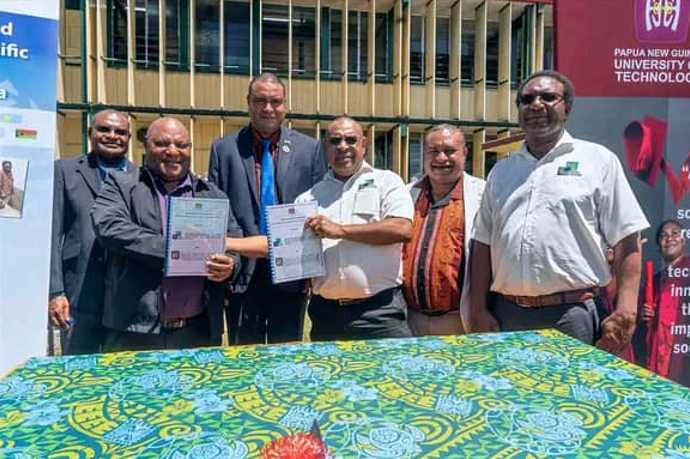
The first Broadband Seismic Station in Lae to strengthen earthquake and tsunami monitoring capabilities, scientific research and disaster preparedness in Papua New Guinea and the Asia-Pacific region was launched by Mineral Resources Authority (MRA) and Papua New Guinea University of Technology (PNGUoT) yesterday.
The project is a joint initiative by MRA, PNGUoT, Geoscience Australia (GA), and the Secretariat of the Pacific Community (SPC) through the Building Safety and Resilience in the Pacific (BSRP) project funded by the European Union.
During the launching, PNGUoT and MRA signed a Memorandum of Agreement (MOA) formalising their collaboration in the operation and maintenance of the station.
The station is the first broadband seismic station incorporated into the Papua New Guinea's National Seismic Network (NSN), operated by the Port Moresby Geophysical Observatory (PMGO), a branch of MRA's Geohazards Management Division, which is the mandated authority for the monitoring of earthquake and tsunami activities in PNG.
The Seismic induction addresses limitations in existing monitoring equipment by providing more reliable measurements of earthquake magnitudes and improved seismic information for scientific research, engineering applications and disaster preparedness.
The Acting Managing Director of MRA, Mr. Harry Kore said the station represents an important step towards strengthening Papua New Guinea's national geohazard monitoring capabilities.
“Reliable seismic information is essential for understanding earthquake activity and improving disaster preparedness. This station will strengthen our national monitoring network and provide more accurate data to support scientific analysis, informed decision-making and information dissemination to protect lives and assets." Mr. Kore said.
Beyond earthquake magnitude measurements, the station provides seismic hazard information, including Peak Ground Acceleration (PGA) values, which measures the level of ground shaking during earthquakes. This information can support engineers in designing buildings and infrastructure to meet earthquake safety standards. The station's data is also expected to support further scientific research and contribute to regional earthquake and tsunami monitoring through information sharing with Pacific partners
PNGUoT Acting Vice Chancellor Professor Garry Sali said the establishment of the Lae Broadband Seismic Station through this collaboration highlights the importance of bringing together scientific expertise and resources to strengthen earthquake monitoring and disaster preparedness in Papua New Guinea.
“This station is an important resource that will help us better understand earthquake activity and provide valuable information for safer infrastructure and disaster preparedness. By combining our expertise and resources, we are also creating opportunities for scientific research, innovation and student learning while contributing to the safety and wellbeing of our communities,” Professor Sali said.