

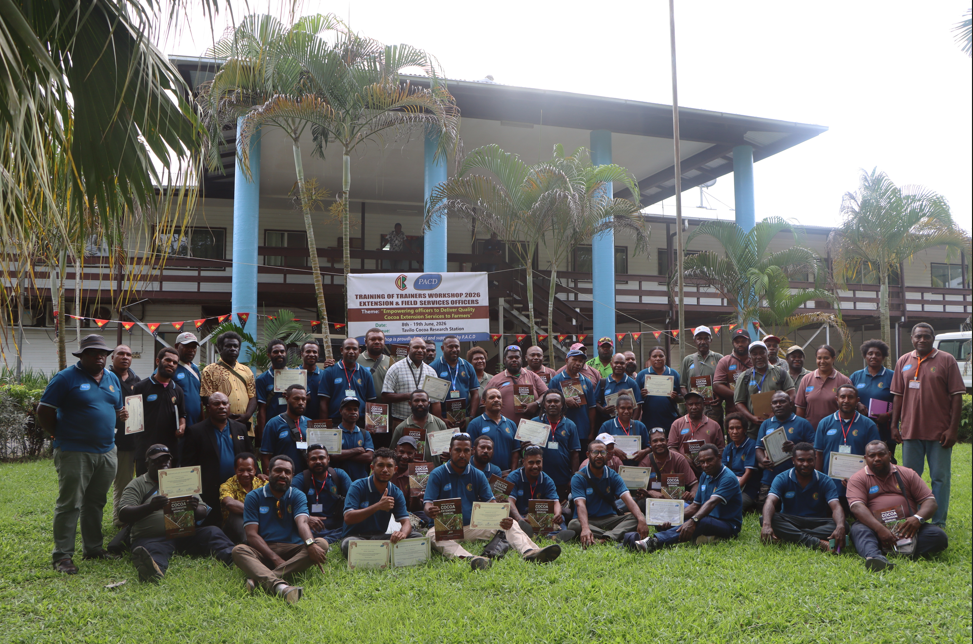
Cocoa Board Chief Executive Officer (CEO) Jesse Tukup Anjen has challenged extension and field officers to return to their respective provinces and actively promote cocoa farming as a profitable business within their communities.
Speaking during the certification and closing ceremony of a two-week Training of Trainers (ToT) program held at the Cocoa Board’s Tavilo Research Centre last Friday, Mr. Anjen emphasized the crucial role participants play in strengthening the cocoa industry.
“Go back to your provinces and spread the gospel of cocoa to your farmers, households and communities. You are now empowered with all the skills and knowledge,” Mr. Anjen said.
He congratulated the participants, acknowledging that each officer, regardless of their specific title, contributes meaningfully to the development of the sector.
“Every one of you plays a unique role. Some have big roles, others have small roles, but every contribution is valuable.”
Mr. Anjen stressed that the training directly aligns with the Cocoa Board’s recently launched corporate plan, urging officers to immediately apply what they have learned to support local growers.
“You are now empowered- go back and utilize that knowledge and those skills to benefit our farmers, our families and our communities.”
A key message highlighted throughout his address was the urgent need for farmers to move beyond subsistence practices and adopt a strictly business-minded approach to cocoa production.
“Farmers cannot just remain simple farmers and become price takers. We need them to see cocoa as a business and always reinforce that message,” he urged.
Mr. Anjen encouraged the participants to fully embrace their new roles as educators, adding that their training manuals should be treated as essential everyday tools in the field.
“You are now trainers. Go out and train other extension officers, partners and our farmers.”
Looking ahead, the CEO revealed plans for the Cocoa Board to develop formal training modules and courses in partnership with the Department of Education (DoE).
These future initiatives include a cocoa-focused school curriculum, and a specialized business management manual tailored specifically for cocoa farming systems.
“With this training, these are the kinds of forward-thinking ideas you must keep in mind and pass on to our farmers.”
Mr. Anjen went on to acknowledge the support of PNG Agriculture Commercialization and Diversification (PACD) Cocoa for funding the program, as well as contributions from various departments that delivered both the theoretical and practical sessions.
He highlighted the growing importance of new cocoa expansion areas, describing the Tavilo Research Centre as the true “engine room” and “heartbeat” of the entire industry.
“This is where everything is generated. The right messages, skills and lessons are packaged here and taken out to the provinces.”
Participants also expressed deep appreciation for the intensive program.
Aileen Arija, a female extension officer representing Oro Province, noted that the program had been highly beneficial for her professional development.
“In the two weeks, we learned a lot. We are honoured and thankful to the Extension and Research teams for sharing their knowledge,” she said.
Similarly, Ario Panuel, an extension officer from the Central Office, thanked PACD for its vital support and highlighted the value of the training, particularly for officers stationed in emerging cocoa regions.
“For me personally, I learned a lot. Coming from a new growth area, this information is very valuable to share with farmers,” he said.
Mr. Panuel noted that while driving cocoa development in areas like Milne Bay presents complex geographical and economic challenges, the precise mix of theory and practical training had equipped participants with the necessary tools to succeed.
“Our farmers are waiting for us. We will go back and help them improve,” he added.
The Training of Trainers program is part of ongoing strategic efforts by the Cocoa Board to strengthen extension services and empower officers to deliver accurate, practical knowledge to farmers across Papua New Guinea’s expanding cocoa-growing regions.