

POSTS BY AUTHOR

Kerebi DAVID
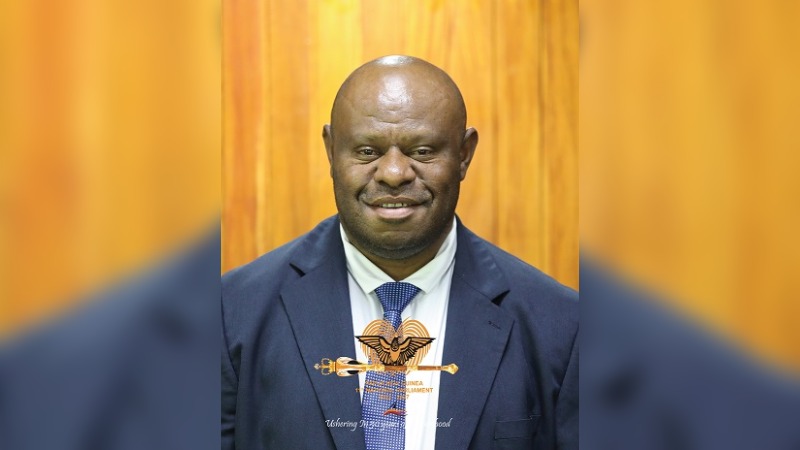 CCDA TO HOST 2nd NATIONAL CLIMATE CHANGE SUMMIT
Minister for Environment, Conservation and Climate Change Simon Kilepa has announced that the Second National Climate Change Summit will take place next week in Port Moresby.
Kilepa said this summit will bring together leaders, experts, and stakeholders from diverse backgrounds engage in substantive discussions centred on the theme “Climate Justice and Social Inclusion”.
“Papua New Guinea is highly vulnerable to the impacts of climate change, rising sea levels, more frequent and severe weather events, and changing rainfall patterns are already affecting the country’s both coastal and highlands communities, agriculture, and infrastructure.”
“The injustice of climate change lies in the fact that our most vulnerable are impacted severely by changes they did not contribute to over the last century, and they are unknowingly bearing that cost.”
Minister Kilepa stated that there is a need to clearly amplify the voices of the most vulnerable in a socially inclusive manner, to make the case for a justified response to the adverse impacts of climate change
He added that there is also a greater need to accelerate access to climate finance to meet the country’s climate change priorities.
“Exploring climate finance at the domestic and international level, through bilateral and multilateral sources, private and public, will be a key agenda at the summit.”
“The outcome of the summit will help the country prepare its response to build community resilience, accelerate access to climate finance, reaffirm the country’s international commitments on climate change and strengthen stakeholder collaboration on climate action in PNG.”
Minister Kilepa also thanked corporate entities and development partners who have come onboard to support the summit.
These sponsors include Ela Motors, National Energy Authority, Food and Agriculture Organization of the United Nations, Global Green Growth Institute, New Zealand High Commission, Australia High Commission, Newcrest Mining Limited, European Union and Vodafone.
“Events of this magnitude come with its own financial and logistics challenges. For this summit, we are grateful to have these sponsors onboard to support. I also thank the management of CCDA and the Summit Organizing Committee for coordinating this Summit,” Minister Kilepa said.
Published on September 9, 2023
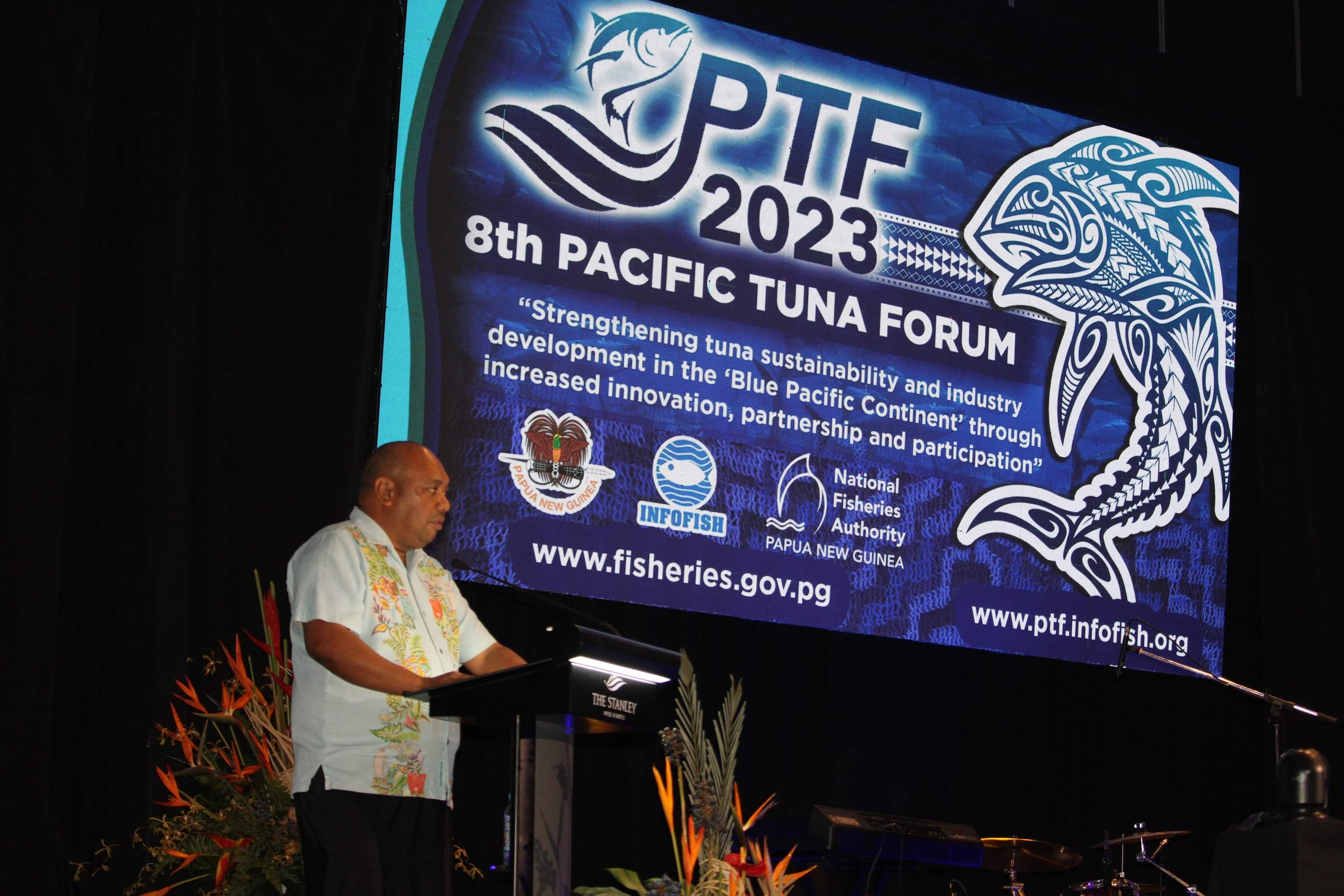 8th PACIFIC TUNA FORUM ENDS ON A HIGH NOTE
The recent two- day 8th Pacific Tuna Forum ended on a high note in the city of Port Moresby where the Minister for Fisheries, Jelta Wong said the Forum was an ideal platform for discussing issues relating to the sustainable Tuna Fisheries arrangement and development.
Minister Wong said that the participation of the Fisheries Ministers from the Pacific Island countries and heads of regional organizations ensured great recognition was given to the Pacific Tuna Forum.
“The high level of presentation witnessed during the last two days, was a testament to genuine commitment for our speakers and moderators to share their knowledge and experience.”
“It also reflects that the program put together by the National Fisheries Authority and INFOFISH captures relevant issues in the tuna fisheries sector.”
Wong added that he hopes that all participants were able to take some key lessons back and can implement them in their own organizations and companies.
“The forums provided an opportunity to reflect on what can be done and to harness our corporative plans, improve our competitiveness and increase the retention of the global value of tuna resources on the Blue Pacific Continent.”
Wong further expressed sincere appreciation to the companies and organizations that have joined in to sponsor the 8th Pacific Tuna Forum.
He further highlighted that the two days of the forum was two days of “Unity for Pacific.”
“Time has changed for the good, now comes the time when all Pacific countries work together to make sure we get greater participation.”
“To all the Tuna Industry players, we are not here to dictate but for partnership, grow the pacific region, because there is a reason and there is hope and that is why we want to grow.”
Meanwhile, the 9th Pacific Tuna Forum will be held in the Fiji Islands in 2025.
Published on September 8, 2023
PIF SECRETARY GENERAL AT 8TH PACIFIC TUNA FORUM
At the opening of the 8th Pacific Tuna Forum this week, Pacific Islands Forum Secretary General, Mr Henry Puna addressed the 8th Pacific Tuna Forum delegates.
As the keynote speaker Secretary General, Mr Puna stated that he was very pleased to be able join all the Pacific Island leaders and stakeholders from around the globe in the 8th Pacific Tuna Forum.
“Indeed, it is wonderful to be back here in this great land of Papua New Guinea – a nation rich in resources and opportunities that can propel the future of our region.”
“It is no secret that we, your Pacific family, have learnt so much and will continue to learn from your leadership and unity on the issues that matter most for our Blue Pacific continent.”
This year’s conference theme, “Strengthening tuna sustainability and industry development in the Blue Pacific Continent, through increased innovation, partnership and participation,” speaks to the 2050 Strategy for the Blue Pacific Continent. “
I am from an Ocean State – for us in the Cook Islands, it is from the Ocean that we derive our history, and our connection to each other – our culture – our livelihoods and our being as Pacific peoples and as custodians of nearly 20% of the earth’s surface, our future as a region lies in our Pacific Ocean”.
He said importantly, the theme shines through in this Forum and added that the innovation and ideas everyone will share, the best practice and challenges on everyone’s agenda, and the way this event is structured goes to the core of partnership, participation, and collaboration.
“These are key to ensuring a sustainable, inclusive, and prosperous Pacific, but as many here will appreciate, how best we rise to the future often depends on how we’ve learnt from the past.”
“I have been in the region my whole life and over time I have worn many different hats that have including that of a Fisheries Minister as well as Chair of the FFC so, I can appreciate the vision and tenacity of those leading the Tuna fisheries sector, whether it be in management, science, negotiations, industry, or the setting of policy.”
Puna further thanked those at the remote forefront of compliance work against IUU fishing – the Fisheries Observers.
“It is your work that makes a sustainable tuna fishery in the Pacific, possible, your efforts, linked to the aspirations of this industry event, will help to ensure the success of the 2050 Strategy’s long-term approach to working together as a region, and as countries and territories, communities and people of the Blue Pacific Continent.”
He further added that economic prosperity is core to 2050 strategy, but the ocean and its resources will underlie the regions prosperity.
“For far too often, our region has been looked upon as “the whole in the donut” and our history as a region has seen our Ocean used by major countries as a nuclear testing ground, or more recently, the perfect abyss for nuclear wastewater.”
But the tides are turning as a region, he highlighted in his speech that it is time now take hold of the future and potential that the Pacific Island people have.
“And in this respect, may I congratulate the people and government of Papua New Guinea and Hon. Minister Jelta Wong and your team for hosting the recent Fisheries Ministerial in East New Britain, to set ambition and action for Pacific nations securing a larger part of the tuna value chain for our Blue Continent”.
“Truly, this endeavor demonstrates initiative and resilience in the face of the climate emergency our Forum Leaders have declared, and I note that the outcomes of your deliberations will be presented to Forum Leaders at their Rarotonga meeting and wish you all the best in this endeavor.”
He also added that the ability to leverage and generate economic prosperity from the natural resources including the ocean goes hand in hand with addressing the most significant threats and complex challenges including:
(i) Climate change and rising sea levels;
(ii) Rising debt levels; (iii) Global economic fragmentation; and of course
(iv) Geo-political contestations.
“Question is, how can we use this era of influence to capitalise on the resources and strengths that we have as a region, to address the key challenges of our time?”
“As I mentioned earlier, I firmly believe that the future of prosperity lies in our ocean – its fishery and its resources.”
If there is one theme in the 2050 Strategy that drives home the global context of all coastal states, it is the Ocean and Environment thematic area and it recognizes and defines our geography as large ocean states but also sustains our economies, cultures, and way of life.
Published on September 7, 2023
8th PACIFIC TUNA FORUM 2023 UNDERWAY
The two- day Pacific Tuna Forum 2023 (PTF 2023), a paramount event in the world of marine conservation and fisheries management, is currently underway at the Stanley Hotel, Port Moresby.
The PTF 2023 gathering is known for its profound impact on the sustainable management of tuna resources and preserving the Western and Central Pacific Ocean (WCPO) as the region contributes almost 60% of the global tuna harvest.
PTF 2023 has drawn international attention as stakeholders come together to address pressing challenges and chart a course for the future of the Tuna Industry.
The Forum is organized by INFOFISH and the National Fisheries Authority (NFA) of Papua New Guinea (PNG) including other regional organizations in the Pacific.
The 8th Pacific Tuna Forum will unite all these voices in "Strengthening tuna sustainability and industry development in the Blue Pacific Continent through increased innovation, partnership, and participation" at all value/ supply chain level.
With the health of the world's ocean facing unprecedented challenges, this forum becomes an essential avenue for collaborative dialogue and action.
There are five key themes to be discussed in this forum: 1) Sustainable Fisheries Management, 2) Ecosystem Conservation, 3) Climate Resilience, 4) Market Access and Trade, 5) Indigenous and local knowledge.
The Forum will showcase technological innovations and best practices that can drive the fishing industry's efficiency and sustainability while reducing its environmental impact.
As the world faces an increased need for collective action to protect the oceans and sustain vital marine resources, the PTF 2023 emerges as a beacon of hope and collaboration.
The decisions and agreements forged during this event will contribute significantly to the sustainable management of tuna fisheries and broader health of our oceans as well.
Published on September 6, 2023
 PNG HOSTS PACIFIC FISHERIES MINISTERS IN KOKOPO
Fisheries and Maritime Resource Minister Jelta Wong with seven Pacific Island Fisheries Ministers and other senior officials in the Pacific arrived in Kokopo, East New Britain over the weekend to attend the Pacific Islands Ministers East New Britain Initiative Dialogue.
The meeting is scheduled to take place today, Monday September 04th at the Gazelle International Hotel, and this dialogue will prepare Pacific leaders to have one voice in the 8th Pacific Tuna Forum, which is set to take place from the 6th to the 7th of September in Port Moresby.
The theme of this East New Britain Initiative is, “Our Fish, Our Future- by the Pacific for the Pacific.
At the arrival of the high profile delegates, Minister Wong highlighted that the initiative is to create more wealth for the Pacific Island Countries, to control the stock of fish which is the Pacific’s own resource.
“Tuna is a growing resource, and it is a migrating resource that moves from one place to another in the Pacific Ocean and every year we lose in illegal, unreported and unregulated Tuna close to about US$45million.”
“Because of this we want to tap into ways and initiatives to stop this illegal fishing in the Pacific region.”
Wong stated that the initiative is to control the Tuna stock so that the world would know that we are united in the Tuna Industry, so that they cannot come and pick off one by one any Pacific Island country.
Furthermore, National Fisheries Authority (NFA) Managing Director Mr. Justin Illakini added that the ENB Initiative provides a platform for all Fisheries Ministers in the Pacific to have the opportunity to dialogue amongst themselves to address two important key issues.
The first key issue is Climate Change, to look at practical ways of implementing and informing the Forum Leaders on development aspirations and how they can continue the Tuna Industry in the Blue Pacific Continent.
The second key issue is to tap into opportunities to maximize economic returns from the Tuna resource.
“This Pacific Islands Ministers East New Britain Initiative Dialogue provides a platform for all Pacific leaders to have the opportunity to have a voice in speaking from their own national level to see how all Pacific islands can collaborate as a region to drive the Pacific Island Interest in the Tuna Industry.”
Published on September 4, 2023
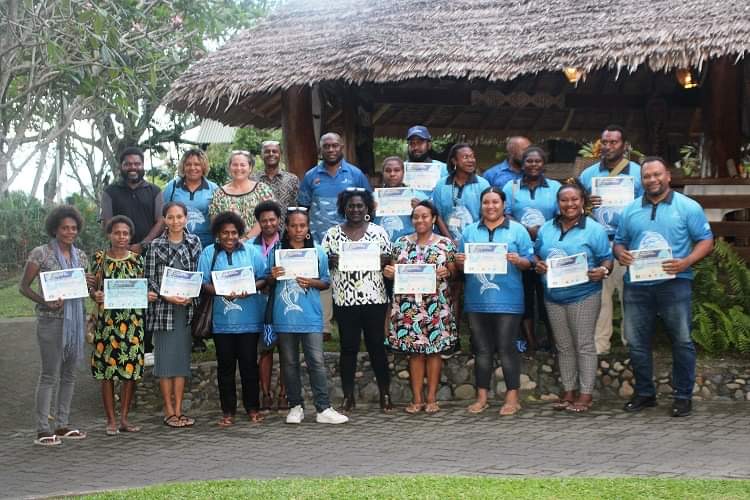 REPORTERS COMPLETE WORKSHOP ON FISHERIES
A total of sixteen reporters and two officers from the East New Britain (ENB) Provincial Administration, we’re the proud recipients of certificates after completing a three-day workshop in preparation for the upcoming 8th Pacific Tuna Forum to be held in Port Moresby this month.
Reporters were taught about the functions of the National Fisheries Authority (NFA) and the Tuna Industry in the country, the region and globally.
They received training and insights to the Blue Pacific Continent and Tuna Sustainability, Tuna Vessels, Tuna markets, the Climate Change and its effects on Tuna, the Fukushima Toxic waste and its effects on Tuna, the Regional and global implication of Illegal, unreported and unregulated fishing in the Pacific and more, including the role NFA plays in the Tuna Industry and other fisheries industries.
Speaking at the presentation ceremony NFA Chairman Mr. Lauri Williams thanked the facilitators for imparting their knowledge about the background on what the fisheries sector does, not only in the country, but around the globe.
“We are a government entity, but we are not just a government entity like all the others, we are a commuting authority.”
“The work that NFA does relates to other government bodies around the world, the secretariat office around the region, therefore it is important to do what we are doing”
“We brought NFA from when it was just a department of Fisheries, Agriculture and Livestock and transformed it into a competing Authority.”
“Thus, Media plays a very important role in telling the story of the fisheries sector moving forward,” said Mr. Williams.
Williams highlighted that Media not only plays an important role in the fisheries sector but also in the Tuna sector.
He highlighted that Tuna is a common denominator that binds the Pacific together.
Williams added that no one owns Tuna; it moves around, Tuna is the fish that never sleeps. Tuna Travels and there is a lot of technical background to how to understand how the Tuna industry works.
“It’s how we manage it, how we work with our brothers in the Pacific and our key stakeholders that control the market, the EU market and the Americans, we all need to work together and participate more in the industry,” he said.
Mr. Williams encouraged all the reporters to do more research, more investigation into the sector and the industry itself so that accurate stories can be told to the people.
“It is a lucrative industry but a sustainable industry also, if we manage it well now, our future generations will still enjoy the benefits of the Tuna industry.”
The workshop was hosted by the NFA in Kokopo and was held at the Kokopo Beach Bungalow from Wednesday 30th August to Friday the 1st of September.
Of the sixteen reporters that participated, twelve were from Port Moresby and four from Kokopo.
Published on September 3, 2023
PNG CONTINUES TO BENEFIT FROM EU FISHERIES MARKET
The Pacific is the only region in the world where the major tuna stocks are biologically healthy and much of the tuna from the pacific are sold in the European Union (EU) market, the single largest market for fish and fishery products worldwide.
Papua New Guinea (PNG) is privileged to be part of that, by having access to the EU market through meeting the Health Certificate and Catch Certificate criteria.
PNG supplies Skipjack Tuna, Yellowfin Tuna, and Albacore Tuna to the EU market. In 2019, the quantity of fisheries exports was doubled from 2014 with 196,000 tons of products exported within five years, with a total export value of K1.3 billion.
PNG’s canned tuna exports benefit from a 24% duty exemption into the lucrative EU market, further leveraging the growth of the PNG Tuna processing sector.
Whilst PNG is thriving in the EU Market, the National Fisheries Authority (NFA) is also exporting other fisheries products into the Chinese market like dried sea cucumbers, prawns, shrimps, lobsters and crabs.
And over the years the National Fisheries Authority strives to keep the country’s tuna industry in the Global market by maintaining its standard and also by improving its service and management system locally.
Published on September 2, 2023
REAL TIME DATA ON FISHERIES ACTIVITIES
One of the most important parts of tuna trade in the region and as well as the globe, is the efficiency in providing factual timely data, something which the National Fisheries Authority (NFA) has improved on since 2015 with its Asset Track System.
Data report is very important as it plays an important role for NFA to continue maintaining its Certificate of Health and Certificate of Catch in order to have access to global markets as well as the European Union (EU) market and the Chinese market.
Mr. Herman Kisokau from the Training and Support from the Rabaul NFA office stated that the Asset Track System is fully encrypted, and it is Digi set certified, meaning that it is very secure and 100% safe.
“This Asset Track System is used within the National Fisheries Authority only and it is web based, meaning you can connect and access it where there is internet service.”
This system is used by PNG Licensed vessels to send in or provide their data through their transponders, they can also provide there GPS locations and intervals to the licensed and fishing authorities and the GPS locations and intervals are displayed on the system.
Mr. Kisokau also stated that this system is used by the observer who is on the fishing vessels observing the fishing process.
“Back in 1996 upwards, everything was manual, and we did not know what was happening on any vessel until it came to harbor and the observer submits the report.”
“However, this has changed, the observer at sea is using a tablet and a transponder they carry every time, and they send real time data back to the observatory.”
Also,the fishing vessels are using tablets and the software and sending the same information to the authority.
“Three data sets are coming in at one time, vessels date, observer data and the industry data to the authority and displaying on one screen in real time.”
When the data is received, the licensing and data management team are responsible for the data, they start to separate the data and give it to responsible business groups in authority to manage the data.
“This is a game changer as we are able to track everything on a vessel through our observer who is on board, thus we are able to also know if the observer is alright or is at risk unlike in the past.”
“With the use of this system, the National Fisheries Authority was able to save five vessels from sinking, because the observer on board sent an SOS through.”
Tuna fishing is the biggest business activity in the fisheries sector; thus, data collection is endless and to translate all these into electronic now, just makes work easier.
This data helps NFA access the market system and maintain its position in the Global tuna and other fisheries product markets.
Published on September 2, 2023
JOURNALISTS URGED TO PRACTICE ETHICAL REPORTING
In recent times the government has been trying to hold media in Papua New Guinea accountable to things that catch everyone's attention, and when the government is trying to do that, they are simply disregarding every good that has been done by the media.
This was emphasized to journalists in Kokopo by Media Council President Mr. Neville Choi.
Mr. Choi said that it is even worse that the government is seeing the mainstream media, traditional media in the same lance as social media.
“Because they see two different things through the same lance, they feel that they can hear the mainstream media, but they cannot control the social media, so they will just group all into one and come up with a policy or law that gives them more control,” said the Media Council President.
“However, as journalists we need to see that we can overcome this through ethical reporting and many times despite us practicing it, we often never really think about it.”
He added that the government of the day does not understand that as journalists, ethics and good moral judgments are the foundation of what journalists do.
“Ethics combined with honest, unbiased and well researched reporting are the two things that set the foundation to build credibility and right now that is what’s under attack, our credibility,” said Mr. Choi.
Mr. Choi further stated that in recent times, the national leaders have led the charge against what they consider to be unregulated media, practicing low standard journalism.
“The only counter to this, is for us, as media practitioners to ensure that our reporting is beyond reproach, criticisms or questions.”
Everyone understands that politicians cannot make the laws or govern things like the media because they are part of the political race regardless of what they say; they remain politicians, part of a national political race.
“However, ironically the government is usually the biggest critic of the media because their work involves and impacts the lives of everyone, and as journalists report on the impact, the government turns and criticizes the media, despite journalists just doing their normal job,” he added.
“Question is how do we stop this?” “The answer is really simple; all journalists must follow media ethics because ethics in the line of reporting the news is the first and the last safeguard against bias.”
Whether we realize it or not, media ethics remains the core of our everyday work as media practitioners.
Published on August 31, 2023
SEX REVERSAL TILAPIA FEED HELPS FISH FARMERS
“Fish farming was a bit slow when it was first introduced by the National Fisheries Authority back in early 2000.”
This is from Mr Jacob Towa, owner of Towa Fish Breeding and Hatchery Farm in the Western Highlands Province.
Mr Towa said this was mainly because fishponds have male and female fish together where they keep on producing more and tend to grow slow and small, thus making farmers lose interest in fish farming.
“However, with the introduction of the sex reversal feed this has greatly improved fish farming in the Highlands.”
“Breeding process of hatchling to fingerlings this has greatly improved fish farming, where breeding is done in breeding farms where only male fingerlings are sold to fish farmers.”
He added that the breeding process is a delicate job where he has to feed and look after the hatchlings for up to 21 days and when they become fingerlings, that is when he sells them off to fish farmers.
“It’s quit a skilful and delicate job where these hatchlings have to be fed 5 meals a day, and I feed them with Sex Reversal Tilapia Feeds (SRT) so the hatchlings can develop into male tilapia fish only.”
“The Sex Reversal Feeds is a game changer, now we can control and grow bigger freshwater fish and farmers do not have to go to the whole process of handling hatchlings to fingerlings, but they buy fingerlings from me at my breeding and hatchery farm and grow their own fish, and all the fingerlings I sell to farmers are only male.”
“Male fish tend to grow faster and bigger than the female fish, thus bringing in more income for the fish farmers and the breeding of male fish is done by feeding all hatchlings with the sex reversal feed,” said Mr Towa.
“Takes 21 days of feeding and 5 times a day which is 8am, 10am, 12pm 2pm and 4pm and SRT is the very first feed we give a hatchling when it comes out of the eggs.”
Mr Towa further told PNG HAUSBUNG that the SRT Feeds are very expensive and hard to buy from any store, so they had to travel to Port Moresby and Aiyura in Eastern Highlands Province to buy new supplies.
However, recently National Fisheries Authority has given 9 Hatchery farmers training on how to produce their own SRT feeds and right now Mr Towa is making his own SRT feed.
“I am excited that now I can make my own SRT feed, I was given the formula to make SRT feed and this has saved me some money and trips.”
With more trips and money saved, he said he has more time now to concentrate on giving trainings, guidance and help to new and interested fish farmers.
Published on August 29, 2023
NSL CLARIFIES DECEASED ENTITLEMENT PAYMENTS
Nambawan Super Limited (NSL) would like to correct misleading information published in a recent front-page article in one of the daily newspapers in one of the daily newspapers regarding a person claiming to be the rightful beneficiary of a late Member.
NSL would also like to provide some clarity around the process which beneficiaries are required to follow to access a deceased Member’s retirement savings.
NSL stated that the person featured in the front-page story is in fact not a nominated beneficiary of the late Member, as incorrectly stated in the newspaper article.
The late Member had nominated another person as the rightful beneficiary and NSL has been in contact with the correct, designated beneficiary and is following the standard process governed by the Superannuation (General Provisions) Act 2000 to progress the payment of the late Member’s entitlements to the nominated beneficiary.
As per this process, the withdrawal application was concluded, and payment was made to the correct nominated beneficiary after all additional documents and requirements were provided to NSL.
The headline of this article was also incorrect in implying that the Authorised Superannuation Funds of PNG operate on a “no next of kin, no payment” basis.
NSL want to clear this and highlight that this is not the case, in instances where a deceased Member has not nominated any beneficiaries or if there is conflicting information left by the late Member or the family of the late Member, the process is lengthier as NSL is required to investigate.
This is an important verification process and ensures that genuine family members’ and beneficiaries’ interests are protected.
The unlisted beneficiaries must provide proof of identification and proof of relationship to the late Member.
Any additional requirements will be communicated to the unlisted beneficiaries on a case by-case basis depending on their specific circumstances.
Interviews are also conducted as a requirement for the verification process and all this information is then reviewed by NSL before a decision is reached and entitlements are then processed and released.
For cases where the beneficiaries are listed, the following standard documentation is required;
A. Completed Separation Authority Form
B. Copy of late Member’s Valid ID (e.g.: driver’s license, work ID, or passport);
C. Statutory Declaration Form confirming the beneficiaries’ identity, date of birth, and their relationship to the deceased member;
D. Nominated Beneficiaries over 18 years of age must have an active bank account and provide copies of their latest bank statement with a valid form of ID; and
E. Demise Letter from Employer and if all required documents are submitted without errors and the beneficiaries are readily available to be interviewed, the entire process takes between three to five days to complete, with payments made to the beneficiaries’ accounts without delay.
The Fund strongly encourages Members to protect their loved ones by ensuring that they review and update their list of beneficiaries at least once a year and it takes only a moment of their time and ensures a smooth and quick process for those they leave behind.
If left undone, however, this can have a profoundly negative impact on families, as they now not only have to deal with the grief and loss of their loved one but also the stress of having to deal with a process that is longer and more strenuous than it needed to be.
NSL seeks to make the process simple; however, the failure to nominate beneficiaries makes it difficult for all parties.
We are obligated to protect our members’ funds and we take this role very seriously because unfortunately, there are many people trying to access funds that don’t rightfully belong to them.
As a Trustee, NSL works to ensure that we abide by the principles of good corporate governance and operate with no other purpose, other than to serve the interests of our members, by growing and protecting their savings and entitlements.
Our members can check their current listed beneficiaries by logging into our online member portal through our website or the Nambawan Super App or they can also call or email our Call Centre team or visit us at their nearest Branch.
Members can update their details by filling out a “Member Detail Update Form” (MDUF), have it endorsed and stamped by their authorised designated human resource signatory, and lodge it at their nearest Branch or via email to our Call Centre team.
The MDUFs can be downloaded directly from the NSL website, requested via email or from our Call Centre agents, or picked up from any of our 23 Branches nationwide.
Published on August 28, 2023
 USAID ASSISTS ENDANGERED LEATHERBACK TURTLES
The United States Agency for International Development through its PNG Lukautim Graun Program (USAID LGP) is working to protect Papua New Guinea’s rich biodiversity with the awarding of small grants to non-governmental organizations (NGOs).
These funds will reduce threats to biodiversity, strengthen traditional landowner’s rights, and promote women’s economic empowerment.
Madang based Non-Government Organisation, Mas Kagin Tapani Association (MAKATA), is among the recipients of these small grants involved in empowering local communities to protect species of critically endangered leatherback sea turtles that share their coastal regions.
With grant support from USAID LGP, MAKATA conducted community journalism training at Alexishafen, Sumkar district, Madang province, to equip coastal communities with skills and tools to create impact news content that depicts the protection of these turtles and other marine species.
Over a two-week period, 32 participants were taught basic content production techniques with hands-on demonstration on the use of the camera to capture still photos and video footage using android phones.
The training also delved into the role of traditional media in citizen engagement, offering insights into strategies that increase audience involvement.
The participants were also trained to engage policymakers, corporate entities, NGOs, donors, and other stakeholders with their content.
With a focus on environmental stewardship, the program aims to ignite voices from local communities, community-based organizations, civil society organizations, churches, and schools.
After the training, graduates received certificates recognizing their newly acquired skills and their contribution to positive transformations in their respective communities.
Participant, Venantius Barrier, from Murukanam, Ward three, Sumgilbar local level government said, “The training has equipped me with skills to create news stories on my community’s involvement in protecting endangered species, especially the leatherback turtles.”
“Thank you MAKATA, and thank you USAID, for funding this training.”
Another participant, Miriam Nanek, from Karkar in the Sumkar Local Level Government also shared similar sentiments.
She stated, “The information on establishing community-based organization and civil society organization is vital to me.”
“I hope to share these with my community and take that approach to form our own CBO to carry out awareness on the protection of endangered species.”
“Thank you, USAID, for making this training possible.”
Published on August 26, 2023